Seen and Unseen: Living with Invisible Disabilities
“But you don’t look sick.”
If you live with an invisible disability, you’ve probably heard that sentence more times than you can count. It’s usually meant kindly. But it carries a quiet assumption: that if an illness can’t be seen, it can’t be that serious.
An invisible disability is any condition that significantly affects daily life without obvious outward signs. No cast, no wheelchair, no visible scar. Just a person doing their best to get through the day, often while managing pain, exhaustion, or dizziness that nobody around them can see. Here’s a closer look at three of them.
This week is the perfect time to talk about it: Invisible Disabilities Week runs October 18–24, a yearly reminder to recognize the millions of people living with conditions others can’t see.
Fibromyalgia: pain without a visible cause
Fibromyalgia causes widespread, chronic pain throughout the body, along with deep fatigue, unrefreshing sleep, and cognitive trouble, often called “fibro fog.” It’s thought to involve the nervous system amplifying pain signals, so ordinary sensations can register as painful.
There’s no blood test or scan that confirms it, which is part of what makes it so misunderstood. Many people spend years being told its stress or “all in their head” before getting a diagnosis. It affects an estimated 2–4% of adults, most of them women.
On a good day, someone with fibromyalgia might seem completely fine. On a bad day, brushing their hair or holding a conversation can take everything they have.
Rheumatoid arthritis: not just “old people’s arthritis”
Rheumatoid arthritis (RA) is an autoimmune disease. The immune system attacks the lining of the joints, causing pain, swelling, stiffness, and, over time, possible joint damage. It’s not the same as the wear-and-tear arthritis many people picture, and it can begin at any age, often between 30 and 60.
RA usually affects joints on both sides of the body, like both hands or both feet. Morning stiffness can last an hour or more. Because it’s systemic, it also brings fatigue, low-grade fevers, and a higher risk of heart and lung problems.
Modern treatments can slow the disease considerably, but flares still come and go. Someone with RA may look perfectly healthy while struggling to open a jar, button a shirt, or climb a flight of stairs.
Vestibular migraine: when the world won’t hold still
Vestibular migraine is a type of migraine where the main symptom is often not headache but vertigo: a sense that you or the room is spinning, tilting, or swaying. Episodes can last minutes, hours, or even days, and some people have no head pain at all.
Other symptoms include sensitivity to light, sound, and motion, nausea, and feeling unsteady on your feet. Busy places like grocery stores, scrolling screens, or riding in a car can trigger or worsen an attack. It’s one of the most common causes of recurring dizziness, yet it’s frequently missed or mistaken for an inner-ear problem or anxiety.
To an onlooker, someone in the middle of an episode might just look tired or distracted. Inside, the ground is moving.
Service dogs: help you can see for illness you can’t
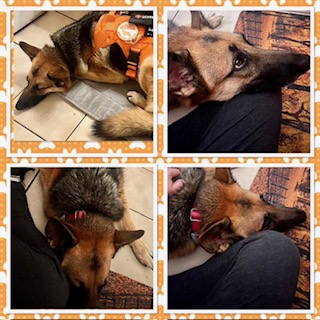
For many people with invisible disabilities, a service dog is what makes everyday life possible. I know this firsthand. My service dog, Zelda Sayre, is with me through all of it:
- She senses dizzy spells before I do. When one is coming, she boops me, so I have time to sit down or get somewhere safe.
- She keeps me steady. When the world starts tilting, she braces and helps keep me from falling.
- She alerts me to severe pain flares. That warning lets me slow down, take medication, or rest before it gets worse.
- She opens doors on days my hands and joints just can’t.
To a stranger, Zelda might look like a well-behaved dog out for a walk with someone who seems fine. To me, she’s my early warning system, my balance, and my independence.
Every service dog is trained for their own handler, so the work varies.
What that help looks like depends on the person:
- Fibromyalgia: picking up dropped items, carrying things, and helping with tasks that hurt to do on a flare day.
- Rheumatoid arthritis: opening doors, pulling off socks or jackets, and bracing so their handler can stand up from a chair.
- Vestibular migraine: providing balance support, steadying their handler during a dizzy spell, and guiding them to a seat or out of an overwhelming space.
A service dog is a working medical tool, not a pet. If you see one in a vest, please don’t pet, call, or distract them, even if they’re adorable. And don’t assume the person doesn’t “need” the dog because they look healthy. That’s exactly the point: the dog is doing a job for a condition you can’t see.
What they share, and how to show up
These three conditions are very different, but they have a lot in common. Symptoms fluctuate, so someone can be fine on Tuesday and bedbound on Wednesday. Diagnosis is often slow. And people living with them spend a lot of energy proving they’re really sick, on top of actually being sick.
A few simple things go a long way:
- Believe people. If someone tells you they’re in pain or dizzy, take them at their word.
- Drop “but you look fine.” Try “How are you really doing today?” instead.
- Be flexible. Canceled plans aren’t personal. Keep inviting them anyway.
- Ask, don’t assume. A quieter restaurant, a seat, or dimmer lights might make all the difference.
- Remember that good days aren’t proof. Feeling better today doesn’t mean the condition is gone.
Invisible doesn’t mean imaginary. The more we understand that the less people have to fight to be believed, and the more energy they can spend on living.